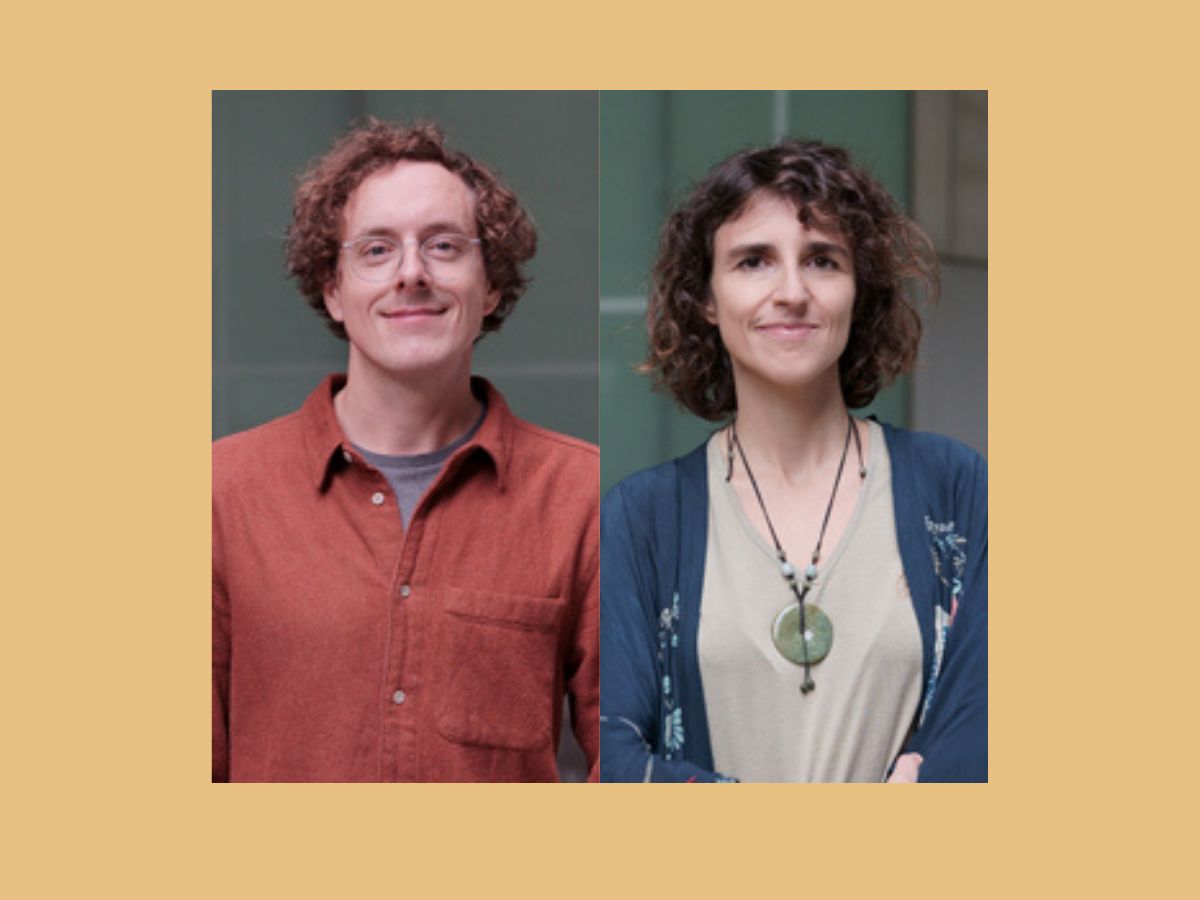
About Mafalda and Jonathan
Mafalda Dias
Mafalda Dias is a Group Leader at the Centre for Genomic Regulation (CRG) since 2022. Before establishing her group in Barcelona, she was a Senior Postdoctoral Fellow at Harvard Medical School (2018–2022). She previously held a Fellowship at the Deutsches Elektronen-Synchrotron (DESY, 2015–2018) and worked as a Postdoctoral Researcher at the University of Sussex (2013–2015). Mafalda obtained her PhD in Theoretical Physics from the University of Sussex in 2013. Her research combines theoretical and computational approaches to address fundamental questions in genomics and evolutionary biology.
Jonathan Frazer
Jonathan Frazer is a Group Leader at the Centre for Genomic Regulation (CRG) since 2022. Prior to this, he was a Senior Postdoctoral Fellow at Harvard Medical School (2018–2022). He has also been a Fellow at the Deutsches Elektronen-Synchrotron (DESY, 2015–2018) and a Postdoctoral Researcher at the University of the Basque Country (2013–2015) as well as University College London (2013). Jonathan earned his PhD in Theoretical Physics from the University of Sussex in 2013. His work focuses on developing machine learning and evolutionary genomics approaches to understand the impact of genetic variation on phenotype and disease.
Research
In the Dias and Frazer Lab, research focuses on harnessing the current era of population-scale human sequencing, global initiatives to generate reference genomes for all life on Earth, and experiments that test the effects of millions of genetic variants. These datasets provide an unprecedented opportunity to transform the use of genomic information in diagnosis and preventative care, as well as in protein and drug design. The group develops machine learning methods—often generative and Bayesian—to predict the impact of genetic variation on phenotype, with a particular emphasis on improving the diagnostic yield of patient sequencing.
From the machine learning perspective, the lab explores how recent advances in deep learning can be adapted to genetic sequence data, which present modelling challenges distinct from those found in other areas of AI. From the evolutionary biology perspective, the team investigates the relationship between fitness and phylogeny, examining how genetic variation across different evolutionary timescales—from within populations to across the entire tree of life—can provide new insights into disease and molecular function.